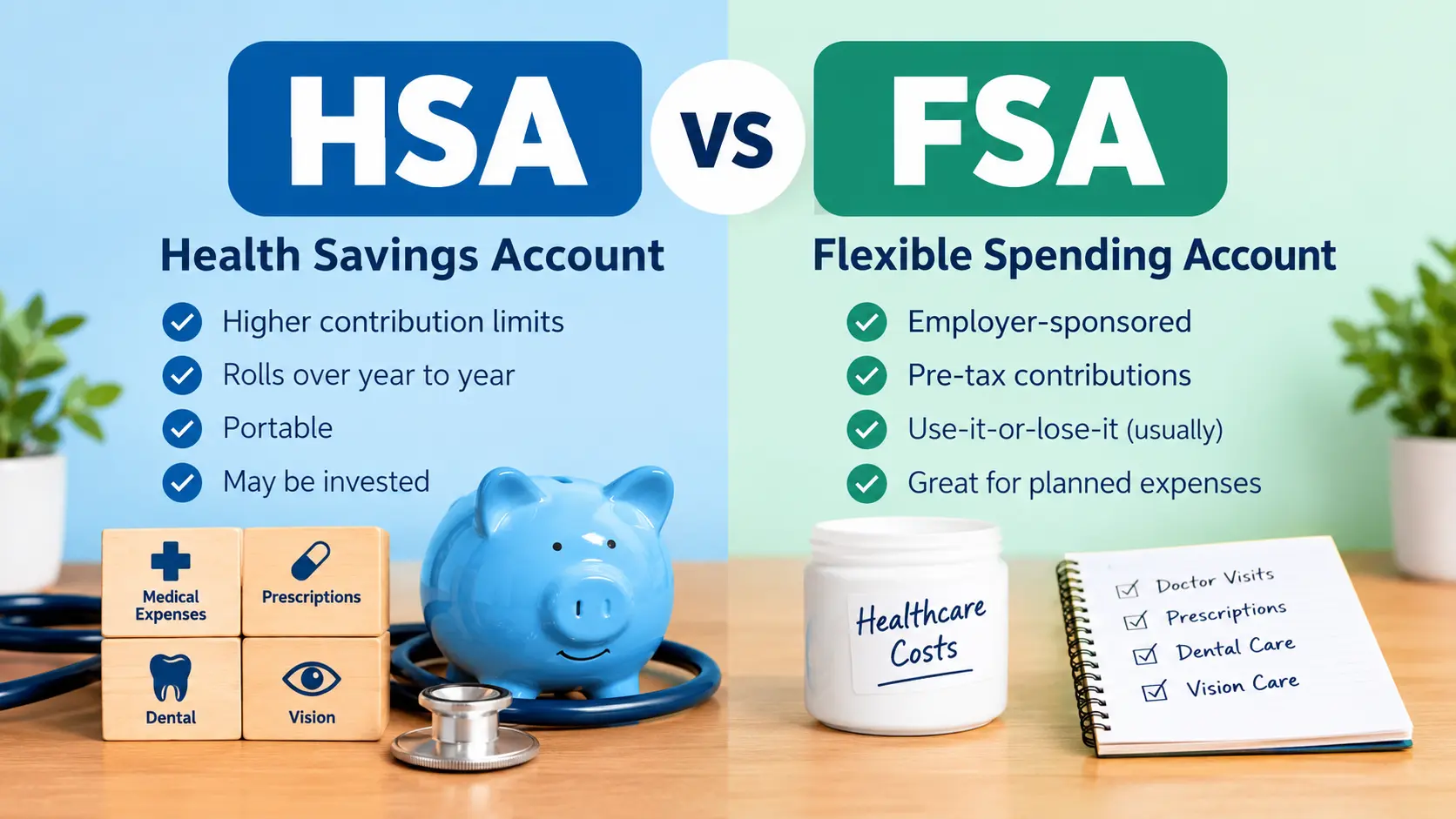
An HSA (Health Savings Account) is available to eligible people with qualifying high-deductible health coverage and lets unused money roll over year after year.
An FSA (Flexible Spending Account) is generally an employer-sponsored benefit that uses pre-tax money for eligible medical expenses, but unused funds may be subject to plan-year deadlines and forfeiture rules.
Key Takeaways
An HSA requires qualifying coverage and generally stays with you if you change jobs.
An FSA is an employer-established benefit and is generally tied to your employer’s plan.
HSA money generally rolls over from year to year and may be invested.
FSA plans generally have use-it-or-lose-it rules, although employers can offer a limited carryover or grace period.
For 2026, the HSA contribution limit is $4,400 for self-only coverage and $8,750 for family coverage. The health FSA salary-reduction limit is $3,400.
HSA vs FSA: What’s the Difference?
Both HSAs and FSAs let you use tax-advantaged money for qualified medical expenses, but they work differently.
An HSA is an account you own if you meet the eligibility requirements. You generally need qualifying high-deductible health plan coverage, and certain other coverage can prevent you from contributing. HSA balances generally stay in the account from year to year.
An FSA is an employer-established benefit. You normally choose an amount to have withheld from your paycheck before taxes, and the money can be used for qualified medical expenses covered by the plan.
The biggest differences are eligibility, ownership, rollover rules, contribution limits, and what happens when you leave your employer.
HSA vs FSA Comparison Table
| Feature | HSA | FSA |
|---|---|---|
| Full name | Health Savings Account | Flexible Spending Account |
| Eligibility | Generally requires qualifying HDHP coverage | Generally offered through an employer |
| Account ownership | Employee-owned | Employer-established |
| 2026 contribution limit | $4,400 self-only / $8,750 family | $3,400 |
| Catch-up contribution | Additional $1,000 at age 55+ | No comparable federal catch-up |
| Rollover | Generally yes | Generally no, although a plan may allow a carryover |
| Investment potential | May be available | Generally not designed for investing |
| Job change | Account generally stays with you | Depends on plan and circumstances |
| Tax advantages | Contributions and qualified withdrawals can receive favorable federal tax treatment | Contributions and qualified reimbursements generally receive favorable federal tax treatment |
| HDHP required? | Generally yes | No |
| Can funds cover qualified medical expenses? | Yes | Yes |
HSA figures for 2026 come from IRS guidance, while FSA rules can depend on the employer’s specific plan.
What Is an HSA?
A Health Savings Account is a tax-advantaged account designed to help eligible people save for qualified medical expenses.
To contribute to an HSA, you generally must have qualifying HDHP coverage and meet other IRS requirements. For 2026, the minimum annual deductible for an HSA-qualified HDHP is $1,700 for self-only coverage and $3,400 for family coverage. The applicable maximum out-of-pocket limits are $8,500 and $17,000.
Who Can Have an HSA?
HSA eligibility depends primarily on your health coverage and other circumstances.
A person generally cannot contribute to an HSA while covered by a general-purpose health FSA or certain other disqualifying coverage. However, some arrangements, such as a limited-purpose FSA or post-deductible FSA, can be compatible with HSA contributions.
2026 HSA Contribution Limits
For 2026, the HSA contribution limits are:
- Self-only coverage: $4,400
- Family coverage: $8,750
- Additional contribution for eligible individuals age 55 or older: $1,000
These limits include contributions made by you and contributions made on your behalf, such as qualifying employer contributions.
How HSA Money Works
One major HSA feature is that unused money generally rolls over automatically. It does not normally disappear at the end of the year.
HSA funds can also potentially earn interest or investment returns, depending on the HSA provider and account rules. Qualified medical withdrawals are generally tax-free.
What Is an FSA?
A Flexible Spending Account, often called a health FSA, is an employer-sponsored benefit that lets employees set aside pre-tax money for eligible health care expenses.
Your employer establishes the plan, and you normally select how much to contribute through a salary-reduction election. Employers may also contribute if the plan allows it.
Who Can Have an FSA?
Unlike an HSA, an FSA does not generally require you to have an HDHP.
However, you typically need to work for an employer that offers an FSA. Self-employed individuals generally aren’t eligible for an employer health FSA.
2026 FSA Contribution Limit
For 2026, the federal salary-reduction contribution limit for a health FSA is $3,400.
If an employer’s plan allows unused funds to carry over, the maximum carryover for 2026 is $680. An employer may instead offer a grace period of up to 2½ months, subject to the applicable rules. A plan generally cannot offer both the carryover and grace-period options for the same health FSA.
How FSA Money Works
FSA funds are intended for eligible expenses during the plan’s coverage period.
One useful FSA feature is that you generally can be reimbursed up to your annual elected amount for eligible expenses during the coverage period, even before you have contributed the entire amount through payroll deductions.
HSA vs FSA: 8 Key Differences
1. Eligibility
An HSA generally requires qualifying HDHP coverage and compliance with other eligibility rules.
An FSA usually depends on whether your employer offers the benefit. You do not generally need an HDHP to participate.
2. Ownership and Portability
An HSA belongs to the account holder. Changing employers generally does not make you lose the HSA balance.
An FSA is an employer-established benefit. What happens when you leave a job can depend on the plan and applicable continuation rules.
3. Rollover Rules
This is one of the clearest differences.
HSA: Money generally rolls over year after year.
FSA: Money generally must be used during the plan year, unless the employer’s plan provides an allowed carryover or grace period.
4. Contribution Limits
For 2026, an HSA allows up to $4,400 for self-only coverage or $8,750 for family coverage.
A health FSA has a $3,400 employee salary-reduction limit for 2026.
5. Tax Benefits
Both accounts can provide tax advantages.
HSA contributions can be made by eligible individuals, employers, or others on their behalf. Contributions generally receive favorable federal tax treatment, and qualified medical distributions are generally tax-free.
FSA salary reductions and employer contributions generally aren’t included in federal taxable income, and qualified reimbursements can generally be tax-free.
6. Investment Potential
Some HSAs allow account holders to invest money once certain provider requirements are met. This can make an HSA useful for people who want to save for future medical costs.
An FSA is primarily designed for current eligible expenses rather than long-term investment.
7. Access to Funds
An FSA has an important feature: you can generally access the full amount of your annual elected contribution for eligible expenses during the coverage period, even though your payroll contributions occur throughout the year.
With an HSA, you generally use the money actually available in the account.
8. Changing Jobs
An HSA generally remains yours when you leave an employer.
An FSA is connected to the employer’s benefit plan, so leaving the job can affect access to the account. Your specific plan and any applicable continuation rights determine what happens.
Can You Have an HSA and FSA at the Same Time?
Sometimes, but not every FSA works with an HSA.
A general-purpose health FSA that reimburses qualified medical expenses can generally make you ineligible to contribute to an HSA.
However, certain types of FSAs can be compatible with an HSA. A common example is a limited-purpose FSA, which may cover eligible dental and vision expenses. A post-deductible FSA may also be compatible under applicable rules.
If you want to contribute to an HSA, check your employer’s FSA rules before enrolling.
Which Expenses Can HSA and FSA Funds Cover?
Both accounts can generally be used for qualified medical expenses under applicable federal rules.
Examples can include certain:
- Doctor visits
- Prescription medications
- Dental care
- Vision care
- Medical equipment
- Diagnostic services
- Eligible medical supplies
The exact rules depend on the expense and the applicable tax requirements. The IRS defines medical expenses as costs primarily related to diagnosing, treating, mitigating, or preventing disease or affecting a body function.
Neither account should automatically be treated as a way to pay every health or wellness expense. An expense that is simply beneficial to general health may not qualify.
HSA vs FSA: Which Account Fits Your Situation?
There is no single account that fits every person.
An HSA may fit well if you have qualifying HDHP coverage, want your unused balance to remain available for future medical expenses, and value the ability to potentially invest HSA funds.
An FSA may fit well if your employer offers one and you expect to have eligible health expenses during the plan year. The account can provide pre-tax savings and convenient access to funds for qualified expenses.
Your health plan premium, deductible, employer contributions, expected medical costs, tax situation, and employer benefit rules can all affect the practical value of each option.
Instead of comparing the account names alone, compare the total cost of the health plan plus the employer’s contribution and account benefits.
Frequently Asked Questions
Is an HSA or FSA better?
It depends on your health plan, expected medical expenses, employer benefits, and how you want to use the money. An HSA offers rollover and portability features, while an FSA can provide convenient pre-tax funding for expected expenses during the plan year.
Does an HSA roll over?
Yes. HSA balances generally roll over from year to year. The money remains available for future qualified medical expenses, subject to HSA rules.
What happens to unused FSA money?
Generally, unused FSA money may be forfeited after the plan year. However, an employer can offer an allowed carryover or a grace period. For 2026, the maximum permitted FSA carryover is $680 if the plan uses the carryover option.
Can you have an HSA and FSA together?
Yes, in certain circumstances. A general-purpose FSA can generally prevent HSA contributions, but a limited-purpose or certain post-deductible FSA can be compatible with an HSA.
What is the HSA contribution limit for 2026?
The 2026 HSA contribution limit is $4,400 for self-only HDHP coverage and $8,750 for family HDHP coverage. Eligible individuals age 55 or older can generally contribute an additional $1,000.
What is the FSA contribution limit for 2026?
The 2026 federal limit on employee salary-reduction contributions to a health FSA is $3,400. Employer plans may have their own rules within the federal limits.
Can HSA and FSA money be used for dental and vision expenses?
Qualified dental and vision expenses can generally be eligible medical expenses, although the specific account and plan rules should be checked before paying an expense.
Final Takeaway
The key difference in HSA vs FSA comes down to how the accounts are structured.
An HSA is generally tied to qualifying HDHP coverage, belongs to the account holder, and allows unused money to remain available from year to year.
An FSA is generally an employer-sponsored benefit designed to help employees pay eligible medical expenses with pre-tax money, but its funds can be subject to plan-year deadlines.
For 2026, the HSA contribution limits are $4,400 for self-only coverage and $8,750 for family coverage, while the health FSA salary-reduction limit is $3,400.
Before choosing either account, review your health insurance plan, employer contribution, expected medical costs, and the specific rules of your employer’s benefit plan.

I’m Dan Brown, the writer behind aniverssyhub.com, where I share heartfelt anniversary wishes, messages, and celebration ideas for every special occasion.
As an anniversary wishes expert, I create meaningful and memorable words to help couples express their love, appreciation, and happiness.